Weekly Blog

Image for Weekly Blog
Tuesday, December 20, 2011

Monday, December 19, 2011
Friday, December 16, 2011
Thursday, December 15, 2011
Wednesday, December 14, 2011
Be ready to clean up your rentals!
Student loan debts delaying home ownership but boosting rentals! View the article HERE
Tuesday, December 13, 2011
Monday, December 12, 2011
Friday, December 9, 2011
Parents Making Big Purchases
Parents buying their children houses. Have you? Will you? Read more HERE
Thursday, December 8, 2011
Wednesday, December 7, 2011
Monday, December 5, 2011
Friday, December 2, 2011
Thursday, December 1, 2011
Friday, November 18, 2011
What houses can you get for under 300k? MSN shows you!
MSN slideshow of beautiful houses that are listed under $300,000! View these houses HERE
Thursday, November 17, 2011
A smaller house making a bigger impact?
Read more to learn how the smaller houses in the market may pack a bigger punch! View HERE
Wednesday, November 16, 2011
Tuesday, November 15, 2011
94% market value!
We found an article you might enjoy! Read about Freddie Mac's average SEO sale HERE
Monday, November 14, 2011
Friday, November 11, 2011
Good tips on selling in a tough economy!
An article that any investor/realtor should take a look at! View this helpful article HERE
Thursday, November 10, 2011
Mortgage payments 40% cheaper than in 2006!
Cheaper payments mean more affordable homes, right? See what the article says HERE
Wednesday, November 9, 2011
Tuesday, November 8, 2011
REM Hub now has a business page on Google+
We are excited to announce that REM Hub now has a business page on Google+! Come add us to your circles and don't forget to +1!
REM Hub on Google+!
REM Hub on Google+!
Sabal picks up $527 million in loans!
This is a very interesting article we found concerning the Sabal Financial Group. read more about their buy HERE
Monday, November 7, 2011
Great tips on the photos for listed homes!
We found an article that can help all of you. When listing a property, do your photos drive clients in? Or out? Learn how to improve HERE
Friday, November 4, 2011
Interesting article regarding families and mortgages!
REM Hub found an intriguing article regarding families and mortgages. Share your thoughts!
This article can be found HERE
This article can be found HERE
Thursday, November 3, 2011
Homeownership rate rises after two years of steady decline!
Come view this uplifting article about the improving real estate market!
View the article about Homeownership rates rising HERE!
View the article about Homeownership rates rising HERE!
Wednesday, November 2, 2011
Learn the 5 great things about homeownership!
There are many advantages to homeownership, see what this article narrowed down as the five greatest things!
View this article HERE!
View this article HERE!
Tuesday, November 1, 2011
ARM mortages not as risky says one economist.
REM Hub discovered an article debating ARM mortgages. View the article HERE!
Monday, October 31, 2011
America's Still Spending
View the interesting article about how America is still spending in a tough economy. View the article here!
Advice all new investors should look into!
Check out REM Hub's latest blog regarding new investors here!
Friday, October 28, 2011
Thursday, October 27, 2011
Wednesday, October 26, 2011
Tuesday, October 25, 2011
Monday, October 24, 2011
The Next Steps in Becoming a Successful Real Estate Investor - REM Hub
The Next Steps in Becoming a Successful Real Estate Investor - REM Hub
View REM Hub's most recent blog on our website!
View REM Hub's most recent blog on our website!
Friday, October 21, 2011
Thursday, October 20, 2011
Top 10 hottest neighborhoods for foreclosures!
Linked In news article: Top 10 hottest neighborhoods for foreclosures!
Read Here
Read Here
Wednesday, October 19, 2011
Tuesday, October 18, 2011
Thursday, October 13, 2011
Wednesday, October 12, 2011
The Future of Homes
If you're involved in real estate, this is important for you!
The Future of Homes
The Future of Homes
Tuesday, October 11, 2011
Monday, October 10, 2011
Friday, October 7, 2011
Thursday, October 6, 2011
Clear Capital: Home Prices Could Near 'Triple-Dip' by Next Spring
Clear Capital: Home Prices Could Near 'Triple-Dip' by Next Spring: Here
Wednesday, October 5, 2011
Tuesday, October 4, 2011
Where to Live Like the Wealthy do for Less
http://realestate.yahoo.com/promo/where-to-live-like-the-wealthy-do-for-less.html
Where to Live Like the Wealthy Do for Less
September 29, 2011
Real estate's Champagne wishes and caviar dreams are waking to a stingy, jobless reality of metropolitan moochers posing as the wealthy.
The U.S. is at 9.2% unemployment and conspicuous housing consumption is constricted by tightening loan requirements, while the average home has fallen 4.6% in price from a year ago, according to the National Association of Realtors. In neighborhoods where housing prices have remained high, properties are increasingly out of reach.
"Even with recent economic softness, this is a disappointing performance with home sales being held back by overly restrictive loan underwriting standards," says Lawrence Yun, chief economist for the National Association of Realtors. "There's been a pendulum swing from very loose standards, which led to the housing boom, to unnecessarily restrictive practices as an overreaction to the housing correction."
| More from The Street.com » 10 Most Walkable Cities of 2011 » The Best Cities for Avoiding the Real World » 10 Most Convenient Cities In America |
But why break your back paying close to seven figures for a closet in one of the most expensive neighborhoods in the U.S. when there's cheaper property nearby? The zip code's cache is nice and all, but even television and Hollywood helped America realize that Alan Arkin's family in Slums of Beverly Hillscould get by on the fringes and that Gabrielle Carteris' Andrea Zuckerman character didn't have to be born or have parents in Beverly Hills: 90210 to get into fictional West Beverly High School.
TheStreet took a look at five of the tonier neighborhoods in America and found five more on the outskirts that gave residents deep discounts while dropping them directly adjacent to all the stores, restaurants, theaters, museums, parks and other amenities that command premium prices from the rich neighbors:
 |
| Manhattan's Inwood is an alternative to the Upper West Side. Photo: flickr | danakosko |
Want to grab a morning bagel with Harvey Keitel at Barney Greengrass, catch the Akira Kurosawa retrospective at Symphony Space, grab some cheese and a baguette at Zabar's and head over to Central Park for the summer concert series? There are two vastly different ways for homebuyers to approach this.
The first is to actually live on the Upper West Side and pay the median $933,400 that Zillow says neighborhood residents are shelling out for their homes. The other is to look just a few clicks up the Hudson in Inwood, which offers Riverside Drive-quality views of the Hudson and the palisades, tree-lined streets and well-kept homes on the neighborhood's west side and stops along the A and 1 subway lines that take residents to any Upper West Side stop within minutes.
While Inwood residents aren't exactly a skip away from the Columbus Avenue Shake Shack or the fossil room at the American Museum of Natural History, they're paying an average of only $356,000 to be pretty darn close without having to cross a river or live in another city. Inwood may as well be called "Where?" during dinner-party discussions, but its proximity to the best of the West Side and the small-town look of some of its blocks despite being situated squarely in Manhattan make it a place worth knowing.
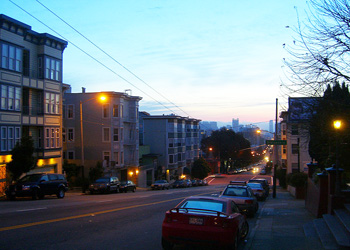 |
| San Francisco's Western addition is an affordable neighborhood. Photo: flickr | permanently scatterbrained |
So you've heard all about San Francisco and would love a place near a lot of parkland with a really great view of the water and Golden Gate Bridge? OK, that'll be $2.8 million, please.
Presidio Heights and "cheap" almost never appear in the same sentence. With a plot adjacent to the sprawling Presidio of San Francisco National Park and the former military installation's fields, historic architecture and views, Presidio Heights is easily the most expensive neighborhood in the city.
The adjacent Marina and Pacific Heights neighborhoods are similarly sought after and sport $1.16 million and $1.05 million median home prices, respectively. There is, however, a neighborhood south of California Street and east of Presidio Avenue that lets its residents live close by for roughly 20% of the cost.
Western Addition is home to two of the city's hospitals, the city's University of California campus, Japantown, the Fillmore district and a number of parks, but is just five blocks away from the Presidio at its closest point and even closer to Presidio and Laurel heights' shops, restaurants, specialty grocers and coffee bars along Sacramento and California streets.
That's if homeowners want them. Western Addition's jazz clubs, farmers markets, Fillmore Auditorium and restaurants like Yoshi's do just fine for themselves without bankrupting the surrounding gentry. This all still needs a bit of perspective, as Western Addition's $576,700 median price tag on homes is on the lower end of San Francisco's offerings, but would easily make it the most expensive neighborhood in Chicago.
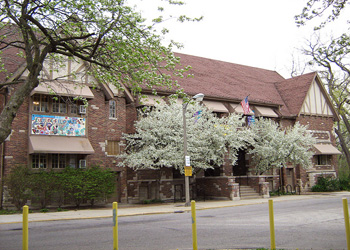 |
| Chicago's Albany Park appeals to some who like North Center. Photo: flickr | Zol87 |
When you live in either of these Chicago neighborhoods, gentrification isn't something that's happening, but what the guy who owned your condo two owners ago heard he was responsible for just before shrugging it off and heading out for post-game beers at the L&L Tavern.
Lake View and its Wrigleyville and Boystown neighborhoods are among some of the most sought-after in the city, especially for those who like the idea of living in a doorman building on North Lakeshore, catching the Brown, Red or Purple lines to work, making a dinner comprising items purchased at Whole Foods and then heading out for a show at Metro, a game at Wrigley or a few drinks on Lakeview or North Clark. They're paying a median of $300,000 to do so, which is considerable in a town where the high-end median is $446,000 for properties on West DePaul.
The same can be said for nearby North Center, which hikes up the premium to $346,000 while adding bars, restaurants, bowling alleys and movie theaters while subtracting the lake and the Wrigley Field-adjacent nightlife. Is there any way to take part without paying some of the highest buy-in prices in the city?
The answer's found a few paces west in Albany Park, where a neighborhood dotted with green space like Ravenswood Manor Park and Ronan Park right on the river also has three brown-line stations just a few stops away from both North Center, Lake View and even Wrigleyville, where the Southport stop provides Albany Park residents a more favorable ride home than what their more monied neighbors are taking when they jam the red line's Addison station after the ninth inning.
Albany Park does just fine on its own, too, as Koreatown's restaurants, the mix of hookah and dart bars at West Lawrence Avenue and North Pulaski Road and the proliferation of bicycle, gadget, tobacco and other shops scattered throughout the neighborhood give the place the type of character that doesn't come one mixed-use residential development at a time. For all this, homebuyers pay about $189,000 on average, which is less than more remote but well-tread gems like the artistically inclined Pilsen neighborhood ($199,000) and little more than still-developing neighborhoods like Humbolt Park ($174,100).
 |
| Hollywood is more affordable than nearby Beverly Hills, Ca. Photo: flickr | letizia barbi |
There was a time when they would let any hillbilly with poor marksmanship, a pickup truck piled high with personal belongings and a little oil money into Beverly Hills with a smile. Now anything less than the $1.9 million median home price wouldn't even secure you a parking spot.
Perhaps there's the stray "dingbat" apartment here or there, but the overwhelming majority of Beverly Hills and the area surrounding have prices that have been star-quality for a good, long time. Beverly Hills is ringed by the Hollywood Hills ($971,200 median home price), Bel Air ($1.74 million), Westwood ($655,700), Century City ($642,600), West Los Angeles ($760,300), Pico-Robertson ($667,600) and Mid-City West ($800,500) neighborhoods, which are all well above the city's $375,900 median.
The only neighborhood directly adjacent to Beverly Hills that even remotely meets that city's median is Hollywood, where a $417,200 price tag has led to increasing gentrification in West Hollywood and throughout the rest of the neighborhood in general. High-end restaurants, coffee shops and bars are open, celebrities and paparazzi are back and home prices were on the rise until the recent dip in the housing market. The lingering memories of drug dealers and 24-hour pizza places may buy a homebuyer some time in snatching up some rich-folk-adjacent property here, but considering it's the one piece of the Beverly Hills ring that isn't ridiculously high-priced as of yet, Hollywood's rebound shouldn't be bogged down much longer.
 |
| Basalt, CO is as outdoorsy as pricier Aspen. Photo: flickr | twred |
It's a little early to be thinking about ski season, but not if your options are plunking down a median $1.99 million for a place or spending a quarter of that to take a one- to two-hour drive at the height of winter.
Aspen and neighboring Snowmass really want skiers to commit when considering property in either area. That $1.99 million isn't great, but it's a deep discount in Aspen after the housing crisis and recession knocked the frosty wind out of home sales and continued to send prices downhill well afterward. The median cost of a home in Aspen was 25% more at this time last year.
It's a similar story in Snowmass, where the $1.25 million median is almost 22% less than it was in summer 2010. Homebuyers can bet against a comeback and wait for prices to plummet to the six-figure mark, but that kind of self-destructive cynicism isn't necessary when there's already a more budget-friendly option down the road.
Basalt, Colo., isn't exactly bargain basement with its $575,000 median home price, but has more to offer than Aspen and Snowmass. Basalt's roughly 27 minutes from the slopes at Aspen and six minutes from Snowmass, but its position on the Frying Pan River and Ruedi Reservior make it a great trout-fishing and boating spot as well. If so inclined, a homeowner can take some of that savings, invest in a decent mountain bike and spend the summer pedaling through Roaring Fork Valley. It's in the middle of the action without being amid the throngs of tourists, which in itself justifies the commute.
Monday, October 3, 2011
The Secret To Real Estate Investing
In today’s market, investing in real estate is not for the faint of heart. You must be able to tolerate a significant amount of risk, because property values are, at best, unpredictable. You may think you’ve bought at the bottom of the cycle, only to discover a few weeks after your purchase that the value of the property has declined again. You may decide to “fix and flip” the property, but later learn that buyers in that part of town are especially scarce. Or, you may have trouble finding a reliable renter.
There are dozens of potential problems connected to real estate investment today, but you can still make plenty of money if you know the secrets. Apparently lots of people are willing to at least stick a toe into the real estate investment pool, whether or not they’re armed with the right information. In August 2011, according to the National Association of Realtors, investors accounted for 22 percent of all homebuyers.
Here are the first five of my top 10 recommendations for successful real estate investing (the second five will be presented next week):
1. Know the total amount of money you have to work with for investment. You shouldn’t estimate, merely contemplate or delegate this vital part of the process. You need to know exactly what you have available in which kinds of resources. How much cash do you have on hand that you’re willing to commit to your investment? How much in mortgages can you qualify for? How much money do you have in other investments that you would be willing to sell? Don’t guess what your resources are and don’t get sucked in to committing to a higher purchase price than you can actually afford.
2. Understand your risk tolerance. If you’re looking primarily for safety, real estate investing probably isn’t for you. If, on the other hand, you’re looking into solid possibilities for profit-making, and you’re willing to do your research, opportunities abound in real estate. Find an online tool to help you discover your risk tolerance. Here’s one to try: http://njaes.rutgers.edu/money/riskquiz/.
3. In this market, evaluate your success through monthly returns on your investment, not by how much it appreciates in a certain time period. We’re no longer in the boom times of 2005. You may not realize a significant jump in value in six months or even a year. In order to realize the most income or appreciation from your asset, you must keep a close eye on how you’re spending your money. You can increase your return by decreasing your holding costs and that can be accomplished by constantly monitoring and tracking your expenses.
4. Don’t get emotionally attached to a property. Investing is a business proposition. Make decisions about the disposition of a property based on sound financial analysis, not on what your gut tells you or how much the asset appeals to you personally.
5. Keep track of every penny spent on the property and earned on the property. A spreadsheet is the old-fashioned way to do this. A new online subscription application that you can take with you anywhere you take your smart phone or tablet lets you manage your real estate portfolio the way you manage your stock portfolio. After all, if you don’t keep meticulous track of all of your investment expenses and earnings, you can miss out on a great opportunity to sell—or buy— a property. The bottom line is that advance tracking lets you make better decisions about your investments. To learn more, visit www.remhub.com.
2. Understand your risk tolerance. If you’re looking primarily for safety, real estate investing probably isn’t for you. If, on the other hand, you’re looking into solid possibilities for profit-making, and you’re willing to do your research, opportunities abound in real estate. Find an online tool to help you discover your risk tolerance. Here’s one to try: http://njaes.rutgers.edu/money/riskquiz/.
3. In this market, evaluate your success through monthly returns on your investment, not by how much it appreciates in a certain time period. We’re no longer in the boom times of 2005. You may not realize a significant jump in value in six months or even a year. In order to realize the most income or appreciation from your asset, you must keep a close eye on how you’re spending your money. You can increase your return by decreasing your holding costs and that can be accomplished by constantly monitoring and tracking your expenses.
4. Don’t get emotionally attached to a property. Investing is a business proposition. Make decisions about the disposition of a property based on sound financial analysis, not on what your gut tells you or how much the asset appeals to you personally.
5. Keep track of every penny spent on the property and earned on the property. A spreadsheet is the old-fashioned way to do this. A new online subscription application that you can take with you anywhere you take your smart phone or tablet lets you manage your real estate portfolio the way you manage your stock portfolio. After all, if you don’t keep meticulous track of all of your investment expenses and earnings, you can miss out on a great opportunity to sell—or buy— a property. The bottom line is that advance tracking lets you make better decisions about your investments. To learn more, visit www.remhub.com.
Next week: the next five recommendations for successful real estate investing.
http://www.remhub.com/2011/10/03/the-secrets-to-real-estate-investing-%E2%80%93-part-1/
Thursday, September 15, 2011
Keeping track of your properties with spreadsheets can be a mess, we can help! http://www.remhub.com/
Sunday, May 22, 2011
Real Estate Management Software
How would you like your investment information in a well organized format, on your finger tips? Welcome to RemHub and BREAK FREE from the spreadsheet!!
Subscribe to:
Posts (Atom)